Class: 9
Subject: Science
Chapter: 1 – Matter in Our Surroundings
Board: CBSE
Resource: Important Questions with Answers PDF
Introduction
Matter in Our Surroundings is the first chapter of Class 9 CBSE Science. It introduces students to the concept of matter, its properties, different states, and the changes that matter undergoes.
Understanding this chapter is important because it builds the foundation for several concepts in chemistry.
To help students prepare for their examinations, we have compiled important questions and answers covering the major topics of this chapter.
Important Topics Covered
- Matter and its properties
- Characteristics of particles of matter
- Diffusion and Brownian motion
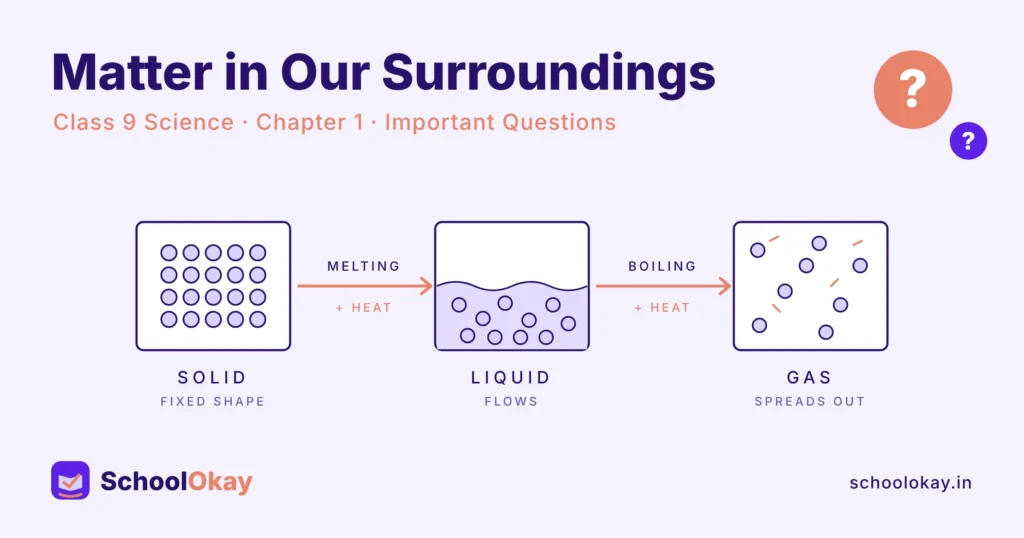
- Three states of matter
- Properties of solids, liquids and gases
- Change of state of matter
- Melting point and boiling point
- Latent heat
- Evaporation and factors affecting evaporation
- Sublimation and cooling effect of evaporation
Important Questions – Matter in Our Surroundings
1. Matter and its Properties
Q1. What is matter?
Q2. Name the three common states of matter. Give one example of each.
Q3. List the important properties of matter.
Q4. Which properties of matter are demonstrated by mixing sugar in water?
Q5. What is diffusion? Give two examples.
Q6. Explain Brownian motion.
2. Three States of Matter
Q7. Define solids, liquids, and gases with examples.
Q8. How do solids, liquids and gases differ in shape and volume?
Q9. Which state of matter can be compressed easily? Why?
Q10. Why is ice lighter than water?
Q11. Compare the properties of solids, liquids, and gases.
Q12. What are the applications of compressed gases?
3. Temperature and Change of State
Q13. Define melting point and boiling point.
Q14. What is interconversion of matter?
Q15. Define latent heat of fusion and latent heat of vaporisation.
Q16. Convert 36°C into Kelvin.
Q17. What is the normal room temperature in Celsius and Kelvin?
Q18. Why is the Kelvin scale considered useful for measuring temperature?
4. Evaporation and Sublimation
Q19. Define evaporation. What factors affect evaporation?
Q20. Explain why evaporation causes cooling.
Q21. Differentiate between evaporation and boiling.
Q22. Why do we wear cotton clothes during summer?
Q23. Why do desert coolers work less effectively during the rainy season?
Q24. Explain the process of sublimation with an example.
Q25. Why do naphthalene balls disappear when kept between clothes?
Value-Based Questions
Students should also practise application-based questions from this chapter.
- Why does the smell of ammonia spread throughout a laboratory?
- Can water boil at temperatures other than 100°C? Explain.
- Why do two ice cubes join together when pressed against each other?
Download Important Questions PDF
We have prepared a separate PDF containing important questions and answers for Class 9 Science Chapter 1 – Matter in Our Surroundings.
The PDF includes questions covering definitions, conceptual understanding, numerical problems, diagrams, and value-based questions.
Preparation Tips for Students
- Understand the basic properties of matter.
- Practise differences between solids, liquids, and gases.
- Learn important definitions and scientific terminology.
- Practise temperature conversion numericals.
- Understand evaporation, sublimation, and latent heat.
- Revise application-based and reasoning questions.
Frequently Asked Questions
Q.1 Which chapter is Matter in Our Surroundings in Class 9 Science?
It is Chapter 1 of Class 9 CBSE Science.
Q.2 Is Matter in Our Surroundings important for CBSE examinations?
Yes. Students should understand its concepts, definitions, differences, and application-based questions.
Q.3 Where can I download Class 9 Science Chapter 1 important questions?
You can download the free SchoolOkay PDF provided above.
Q.4 Should students practise numerical questions from this chapter?
Yes. Temperature conversions and questions involving latent heat should be practised.
SchoolOkay – Making learning simpler for students.