Class: 10th
Subject: Mathematics
Board: CBSE
NCERT Chapter: 1, Ex 1.1 – Real Numbers
Academic Session: 2026–27
Introduction to Real Numbers
Mathematics is all around us, and numbers are one of its most important foundations. From simple calculations to complex mathematical problems, numbers help us understand and solve different situations in everyday life.
In Class 10 CBSE Mathematics, the first chapter is Real Numbers. This chapter introduces students to important number concepts and mathematical properties that help build a strong foundation for higher studies.
You have already studied natural numbers, whole numbers, integers, rational numbers and irrational numbers in previous classes. In this chapter, you will revisit these concepts and learn more about prime factorisation, the Fundamental Theorem of Arithmetic, HCF and LCM.
Let’s understand what this chapter covers and how you can prepare for it.
What Are Real Numbers?
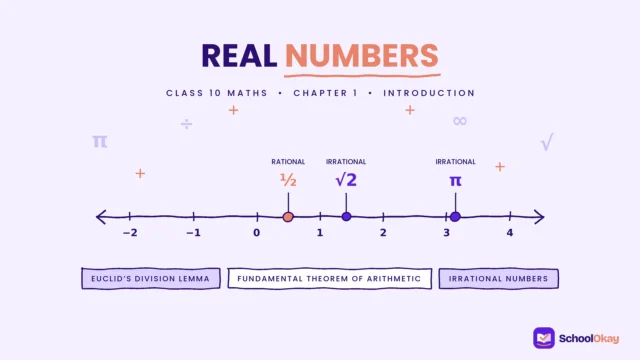
Real numbers are all the numbers that can be represented on a number line.
They include two major categories:
- Rational Numbers: Numbers that can be expressed in the form p/q, where p and q are integers and q is not zero.Examples: 1/2, 3/4, 5, -2 and 0.
- Irrational Numbers: Numbers that cannot be expressed as a fraction of two integers. Their decimal expansions are non-terminating and non-repeating.Examples: √2, √3, √5 and π.
Together, rational and irrational numbers form the set of real numbers.
Important Topics in Class 10 Maths Chapter 1
1. Fundamental Theorem of Arithmetic
The Fundamental Theorem of Arithmetic is one of the most important concepts in this chapter.
It states that every composite number can be expressed as a product of prime numbers, and this factorisation is unique apart from the order of the factors.
For example:
360 = 2 × 2 × 2 × 3 × 3 × 5
Or,
360 = 2³ × 3² × 5
This method is known as prime factorisation.
2. Prime Factorisation
Prime factorisation means expressing a number as a product of prime numbers.
For example:
84 = 2 × 2 × 3 × 7
Therefore:
84 = 2² × 3 × 7
Prime factorisation is useful for solving questions related to HCF and LCM.
3. HCF (Highest Common Factor)
HCF is the greatest number that divides two or more given numbers exactly.
For example:
Find the HCF of 24 and 36.
Prime factorisation:
24 = 2³ × 3
36 = 2² × 3²
Taking the common prime factors with the smallest powers:
HCF = 2² × 3 = 12
Therefore, the HCF of 24 and 36 is 12.
4. LCM (Least Common Multiple)
LCM is the smallest positive number that is exactly divisible by all the given numbers.
Using the same example:
24 = 2³ × 3
36 = 2² × 3²
Taking all prime factors with their greatest powers:
LCM = 2³ × 3²
LCM = 8 × 9 = 72
Therefore, the LCM of 24 and 36 is 72.
5. Relationship Between HCF and LCM
There is an important mathematical relationship between HCF and LCM for two positive integers.
HCF × LCM = Product of the two numbers
For example:
24 × 36 = 864
HCF × LCM = 12 × 72 = 864
Both sides are equal.
This relationship can help you solve different questions in your NCERT textbook.
Download the PDF solution of chapter one math Real Numbers here. Ex 1.1 NCERT solutions.
Why Is Chapter 1 Important for Class 10 Students?
Real Numbers is an important chapter because it develops your understanding of number properties and mathematical reasoning.
Here are some reasons why you should study it carefully:
- It strengthens your understanding of numbers.
- It helps you learn prime factorisation.
- It improves your problem-solving skills.
- It introduces important mathematical theorems.
- It builds a foundation for further mathematical concepts.
How to Prepare for Real Numbers?
If you want to score well in your Class 10 Mathematics examination, follow these simple preparation tips:
1. Understand the Concepts
Do not just memorise formulas. Understand how prime factorisation, HCF and LCM work.
2. Practise NCERT Examples
Go through the solved examples before attempting the exercises.
3. Solve Exercise 1.1
Practise the questions from NCERT Exercise 1.1 and understand each step of the solutions.
4. Learn Mathematical Proofs
Pay attention to the reasoning used in mathematical proofs. Write each step clearly.
5. Revise Regularly
Make short notes of important definitions, formulas and methods. Regular revision will help you remember the concepts.
Frequently Asked Questions (FAQs)
Q1. What is Chapter 1 of Class 10 CBSE Maths?
Chapter 1 of Class 10 CBSE Mathematics is called Real Numbers.
Q2. What are the main topics in Real Numbers?
The chapter covers real numbers, prime factorisation, the Fundamental Theorem of Arithmetic, HCF and LCM, and related mathematical concepts.
Q3. What is the Fundamental Theorem of Arithmetic?
It states that every composite number can be expressed as a product of prime numbers uniquely, apart from the order of the factors.
Q4. What is the difference between HCF and LCM?
HCF is the greatest common factor of given numbers, whereas LCM is their smallest positive common multiple.
Q5. How should I prepare for Chapter 1 Real Numbers?
Start with the basic concepts, practise prime factorisation, solve NCERT exercises and revise important mathematical rules.
Conclusion
Real Numbers is a great starting point for Class 10 Mathematics. It helps students understand the properties of numbers and develop logical and analytical thinking.
Take your time to understand each concept, practise the NCERT exercises and revise regularly. A strong understanding of this chapter will make your mathematics preparation easier.
Start learning with SchoolOkay!
Explore our Class 10 Mathematics study materials, chapter notes, NCERT solutions and additional practice questions to improve your preparation for the CBSE Board Examination.
SchoolOkay – Making learning simpler for students.